*A Counsellor’s Perspective on Emotional Pressure, Suppressed Feelings and Mental Well-being
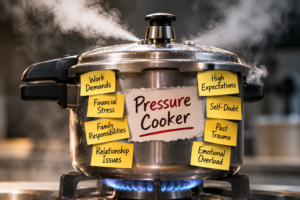
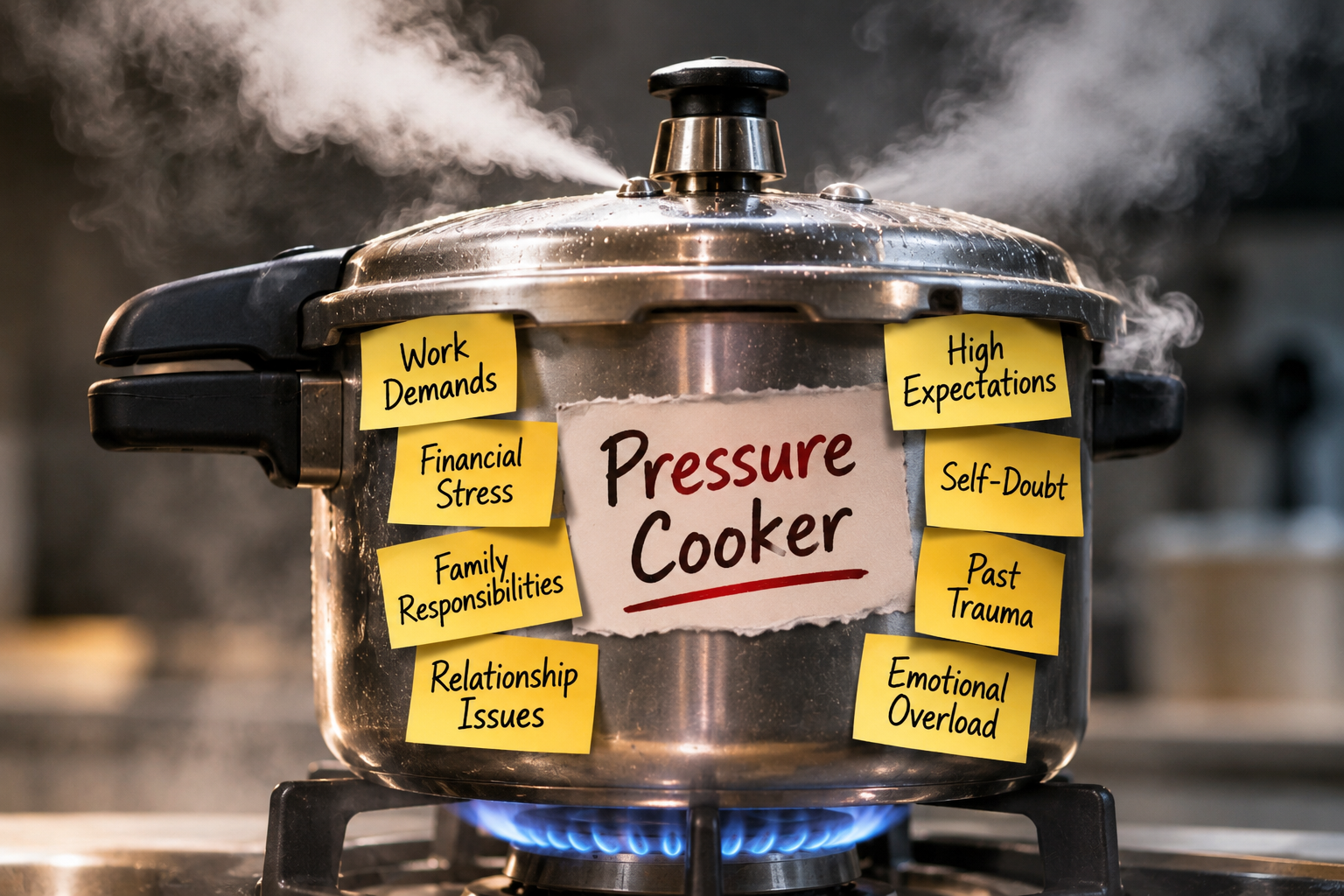
Imagine a pressure cooker placed over a flame. As the heat increases, pressure gradually builds inside. At first, everything may appear normal from the outside. The lid remains closed, and the cooker continues to function. However, beneath the surface, pressure is accumulating. If the pressure is not properly released, it may eventually reach a point where the cooker can no longer contain it.
Human emotions work in much the same way.
From a counsellor’s perspective, the pressure cooker is a powerful analogy for understanding how people experience emotional stress, psychological pressure and suppressed feelings. Every individual encounters challenges in life, whether through relationship difficulties, family expectations, workplace demands, financial struggles, personal disappointments or unresolved emotional wounds. While some people express their feelings openly, others learn to keep everything inside, believing that remaining silent is a sign of strength.
However, emotions that are repeatedly suppressed do not simply disappear. They may accumulate beneath the surface, gradually affecting a person’s emotional and psychological well-being.
The Heat: Everyday Stress and Life’s Challenges
In a pressure cooker, heat is what creates pressure. Similarly, in human life, stressors act as the heat that intensifies emotional tension.
A person may be dealing with multiple responsibilities while trying to meet the expectations of others. They may feel obligated to remain strong for their family, perform well at work, maintain relationships and fulfil social expectations. Although each responsibility may seem manageable individually, the combination of these demands can become overwhelming.
As counsellors, it is important to recognise that emotional distress does not always come from one major traumatic experience. Sometimes, it develops through a series of small but continuous pressures that gradually become too much to carry.
A person who constantly says, “I’m fine,” may actually be struggling silently.
The Closed Lid: Suppressing Emotions
The lid of a pressure cooker represents emotional suppression. Many individuals are conditioned to believe that expressing sadness, anger, fear or disappointment is a sign of weakness. As a result, they hide their emotions to avoid judgement, conflict or rejection.
Some people remain silent because they do not want to burden others. Others suppress their feelings because previous experiences have taught them that nobody will listen or understand.
From a counselling perspective, emotional suppression can prevent individuals from recognising and addressing their underlying needs. Unexpressed emotions may eventually emerge through irritability, anxiety, emotional exhaustion, withdrawal, difficulty sleeping or unexpected emotional reactions.
It is important to understand that being emotionally strong does not mean pretending that nothing hurts. True emotional strength includes having the courage to acknowledge what we feel.
The Pressure Build-Up: When Emotions Become Overwhelming
As pressure continues to build inside a pressure cooker, the internal tension increases. Human beings can experience something similar when they repeatedly ignore their emotional needs.
A person may tolerate unhealthy relationships, workplace stress, family conflicts or continuous criticism for an extended period. They may convince themselves that they can handle everything until one seemingly insignificant incident triggers an overwhelming emotional response.
For example, someone who has been experiencing months of emotional stress may suddenly break down after receiving a small criticism. To an outsider, the reaction may appear disproportionate. However, the reaction may not be about that single incident. It may represent months or even years of accumulated emotional pressure.
As counsellors, we must look beyond the immediate emotional reaction and explore what may have contributed to it.
Sometimes, the problem is not the last drop of water. It is the cup that has been overflowing for a long time.
The Release Valve: Healthy Emotional Expression
A pressure cooker is designed with a release valve to regulate internal pressure. Without an appropriate mechanism for releasing pressure, the cooker may become unsafe.
In human life, healthy emotional expression serves a similar purpose.
Talking to someone trustworthy, seeking professional counselling, setting personal boundaries, practising mindfulness, journaling and allowing ourselves to acknowledge difficult emotions can help us manage psychological stress.
Counselling provides a safe and non-judgemental environment where individuals can explore their feelings, understand their emotional triggers and develop healthier coping strategies.
A counsellor does not simply encourage someone to release their anger or express every emotion without consideration. Instead, counselling helps individuals understand their emotions, recognise their needs and respond to difficult situations in constructive ways.
Emotional regulation is not about eliminating emotions. It is about learning how to experience and manage them without allowing them to control our behaviour.
The Explosion: When Emotional Pressure Reaches Its Limit
When pressure becomes overwhelming and remains unaddressed, individuals may experience emotional breakdowns, intense anger, anxiety, withdrawal or burnout.
Sometimes, people who have remained silent for years suddenly reach a breaking point. They may cry uncontrollably, become emotionally distant, lose motivation or struggle to function in their everyday lives.
It is important not to label these individuals as weak, dramatic or overly sensitive. Their reactions may reflect emotional difficulties that have been ignored for too long.
From a counsellor’s perspective, such moments should be approached with empathy rather than judgement. Instead of asking, “Why are you reacting this way?”, a more compassionate question would be, “What have you been carrying that nobody has noticed?”
This shift in perspective allows us to understand the person behind the emotional reaction.
A Counsellor’s Message: You Do Not Have to Carry Everything Alone
The pressure cooker analogy reminds us that every individual has emotional limits. Nobody can continuously absorb stress, disappointment, rejection and emotional pain without needing time, understanding and support.
We often encourage people to be strong, patient and resilient. However, we sometimes forget to remind them that they are also human beings who need rest, reassurance and emotional connection.
As counsellors, our responsibility is not to judge people for reaching their breaking point. It is to help them understand their emotional experiences, identify the sources of their pressure and discover healthier ways to cope.
Seeking help is not an admission of failure. It is an act of self-awareness and courage.
A Message to Society
We should stop assuming that people who remain quiet are always doing well. Silence does not necessarily mean peace, and a smile does not always mean happiness.
Some individuals are fighting battles that nobody can see. They continue showing up, fulfilling responsibilities and supporting others while quietly struggling with their own emotional burdens.
Let us create a society where expressing emotions is not considered weakness, where seeking counselling is not associated with shame and where people feel safe enough to say, “I’m not okay.”
Remember, a pressure cooker needs a release valve to function safely. Likewise, human beings need healthy ways to process their emotions.
You do not have to wait until you break down before you give yourself permission to seek help. Sometimes, the strongest thing you can do is to acknowledge that the pressure has become too much and allow someone to help you carry it.
Take The First Step
The Healing Cove offers individual, private parent and family with ADHD children counselling in Singapore and online. If work stress has begun to take over your life, a 50- or 75-minute session can be a starting point to pause, reflect and find a more sustainable way forward.
If you feel at immediate risk of harming yourself or someone else, seek urgent help. In Singapore, call 995 for emergency medical assistance, contact national mindline 1771, or call Samaritans of Singapore at 1767.